- Apr 16
Here's how I pitch to clients and get responses
Many years ago, when I was just starting my career, I was afraid of seeming "not good enough" to write to potential leads who didn't know me and hadn't seen my portfolio before. I kept postponing it, thinking that very soon the moment would come when my portfolio would be professional enough / complete enough / beautiful enough / good enough / right enough / [fill in with your own adjectives]. But the truth is, it will never be that – the nature of our creativity is that we always doubt ourselves (at least a little) and compare ourselves to others.
So here's the thing: you as you are is already ENOUGH to start taking action and begin communicating with clients! For every product or service, there's a buyer somewhere, and in such a vast sea of businesses around, there are definitely those who are looking for exactly your style or approach to work, and you'll speed up your potential happy meeting if you start your cold email outreach as soon as possible.
Spark Mail Illustration for Readdle | AppStore Feature | by Irene Neyman
Let's start with why email outreach doesn't work for some creatives. I often receive such emails from freelancers, as my studio collaborates with creatives and designers, and I see recurring mistakes.
Why your emails are being ignored
-
First of all, know who you're writing to:
Do your research and find exactly those who would potentially be interested in your services. Are you sure that this particular company would be in an advantageous position by working with you? If the answer is "yes, of course!!!" then certainly add this lead to your contact database for future email outreach!
-
Emails that are too long:
Nobody likes to read for a long time, especially now when everyone is very busy and nobody has time. Never ever write your entire education or career history; nobody will read that.
-
Irrelevant description of experience/projects:
What's the point of beautifully describing your experience if it's completely unlike what your potential lead works with?
-
Non-clickable / broken links:
Consider that your email will be immediately closed and they'll move to the next one if the clickable word "portfolio" contains a broken link. Again, nobody has time to search for you independently, so make people's lives easier.
-
Email written for "Dear hiring manager":
This is the worst thing you can do. I'm serious, even getting the name wrong isn't as bad as writing this!
-
Being too salesy:
Nobody likes being sold to from the first line. Sales phrases sound fake and immediately push people away. Better to show you sincere interest in their business, not in selling your services.
Formula for an effective email
You should remember what the main goal of your email is – it's not to tell everything you can tell about yourself hoping that it will interest someone. No-no! The goal of the email is simply to get the first response. Any response. Short, long, rejection, interest – it doesn't matter. A response shows that your email was actually read, and from there you can build relationships and make notes for yourself.
-
Know who you're writing to:
When adding potential leads to your database4, over time you might forget who these companies/people are. Do light research before writing to someone, as this will help form an understanding of the brand and make appropriate adjustments to the email context.
-
Write briefly and to the point:
Don't write your entire education or career history; briefly about who you are, why you're writing, what you can do / how you can help, and your portfolio links. Nobody likes to read for a long time, remember?
-
Personalization at the beginning:
It will be a huge plus if you include a super short and simple sentence about why you're writing to them. This can be something incredibly banal like "I loved your latest project [include the project title] with all these funky character illustrations!", but this will make your email much more sincere and warm.
-
Examples of specific work:
Or a link to a portfolio website with your best (!!!) work. I additionally attach my portfolio in PDF format – I give a choice for those who prefer to open it instead of the website.
-
No pressure:
Be sincere and kind, be yourself and simply offer to chat and your help now or in the future! People appreciate knowing that you're interested in working with them, even if they don't have anything for you right now.
Email templates I use
Since I started sending cold emails to potential leads, a lot of time has passed. All these email attempts were different and contained different formats, content, and tone of voice. Over time, I refined them and now I have several templates that I use regularly and that really work for me!
Remember:
☝️ This is just a direction, and ideally, you should slightly modify emails to be individual and personalized.
☝️ Also, update based on your communication style and who you are.
☝️ Try to spend 2-3 minutes studying the company before writing to them – this will help modify the email and add more personal opinion.
☝️ I'm not a native English speaker, so there might be some spelling mistakes 🙃
Email template #1:
Cold outreach to new brands / agencies
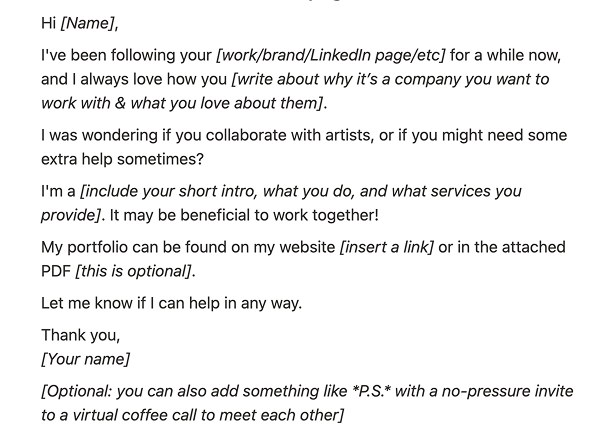
See how it’s simple and short? Keep that in mind and update to your style!
I received 20 responses from around 64 emails I sent, which is about 30% of the response rate! For cold outreach, this is a pretty good number.
Email template #2:
Outreach to previous leads that never became clients
Okay, now let's imagine that someone once reached out to you for your services, but the project never happened – it happens! But by saving this lead, you can always write to them again (say, in 2-3 months) to stay on their radar and remind them about yourself.
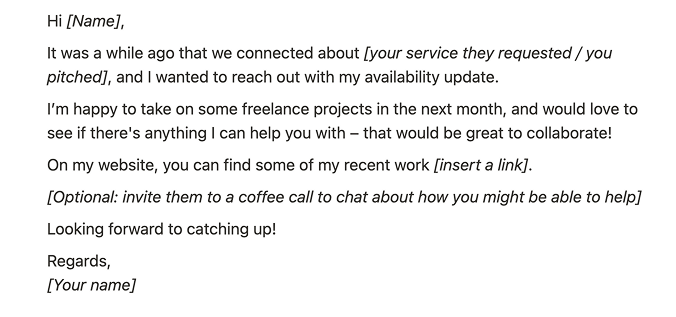
Writing such emails and reminding people about yourself should be a habit, only then will there be results. I mentioned this a bit and other tricks in another blog.
Follow up strategy
If they didn't respond to you, it doesn't mean you're not interesting. It might mean they simply forgot about your email. Don't be afraid to remind them about your emails. You don't need to do this every day, of course, but once after 4-6 days will be enough. After that, write again in 1-2 months, not earlier.
I mentioned the importance of following up here.
Email template #3:
Follow up to those who didn’t respond
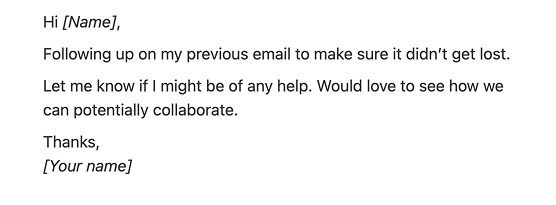
Yes! It's that simple!
You don't need to repeat everything that was said before again. Just a regular reminder will be appropriate. You will get additional responses after follow ups like this as well!
So, now you have practical tactics and templates for your cold outreach, so go ahead and update, write your strategy, and send emails!! Somewhere out there is work that's waiting specifically for you.
If you have additional questions or thoughts about this topic, post in the comments below!
As always, thanks for reading!

Have any project or collab inquiries?
Let’s chat! Feel free to book a discovery call or email me with your ideas to see how we can work together.
Consult calls
Get professional feedback on your creative work and learn how to make your portfolio stand out, or just chit-chat about all things illustration and design in a 1:1 session with me!